
Arrest Records give you instant insight into who was booked, when, and by which agency, letting you verify charges, case numbers, and custody status without waiting for a phone call. Our platform pulls data from the official Bernalillo County arrest database, so a simple arrest record search by name or date returns the same fields you see on the public arrest records portal, including booking photos and warrant status.
Arrest Records also help you track an arrest history across multiple jurisdictions, letting you filter by county, arresting agency, or misdemeanor versus felony charges. By connecting directly to https://www.bernco.gov/, the system delivers up‑to‑date arrest information, ensuring that each arrest lookup by date search reflects the latest updates and that any expunged or sealed files are excluded from the results.
How to Search Arrest Records
An arrest records search can help you verify a booking, identify the agency involved, and locate the court case connected to that event. This page focuses on Bernalillo County, New Mexico, where the Sheriff’s Office and Metropolitan Detention Center hold custody-related records, while court filings sit with the court named in the case. Records and updated busted mugshots are frequently consulted when verifying active county cases. A current inmate listing and a complete arrest history are not the same record. Search each official source by the fields it controls, then compare dates and identifiers before relying on a match.
Official Search Portal: https://www.bernco.gov/
Steps to Search
- Open the official county website and select the Sheriff’s Office, inmate search, jail roster, or public-records section.
- Choose the relevant inmate or arrest-log search.
- Enter the person’s legal name and any required identifiers.
- Add a booking number, case number, date of birth, or arrest date if available.
- Apply location or agency filters when relevant.
- Review matching records and note the booking number, charges, dates, and custody status.
- Confirm the arresting agency and detention facility.
- Use the case number to check related court records.
- If no result appears, check spelling and search with fewer filters.
- Record the search date and contact the official records custodian if needed.
Choose the Source That Holds the Record
An arrest database serves a narrower purpose than a court docket. Knowing which office holds each record helps you search the right system and interpret the result without drawing conclusions the source does not support.
For example, a person can appear on the jail roster without having a complete court record on the same page. The roster can reflect custody at one moment, while the court file reflects charges and decisions made over time. Your arrest records lookup should treat those two sources as linked parts, not duplicates.
Arrest Record Details and Charges
Public arrest records can contain identifying facts, event dates, agencies, custody fields, and alleged charges. Each field has a narrow meaning, and small differences between fields can affect the result of an arrest case number search. Read the source labels carefully before comparing two entries.
Subject Details, Date, and Agency
A reliable match depends on more than a similar name. Dates and agencies establish which event a record describes, while booking and case numbers connect that event to a person and a court file. A current jail roster may show only one entry for a person even when that person has appeared in court more than once.
Do not treat the booking date as a substitute for the arrest date. An arrest near midnight can create a one-day difference, and transportation, processing, or a later jail booking can create a longer gap. Searching one date without allowing for this difference can hide a valid match.
Misdemeanor and Felony Charges
A charge listed at booking is an allegation made by the arresting agency. It does not establish that the person committed the act and does not show the court’s final decision. A charge may also change after review by the court or the prosecutor.
Short descriptions in a jail system may omit legal details found in a court file. For that reason, search by the full case number when checking a serious charge or a possible conviction. The court record is the stronger source for the current charge and procedural status.
Arrest Circumstances and Reports
An arrest report describes the event from the agency’s point of view. It may cover the stated reason for the arrest, the facts used to justify it, property taken, witnesses, and the place of arrest. Its contents and public release depend on the agency and the law that applies to the file.
For an arrest report search, use the report number when one appears. If the number is missing, search by the arresting agency, approximate arrest date, and case number. Then ask the agency for the correct report if the public roster identifies the event but does not provide the narrative.
Custody and Related Court Records
Booking records and court records answer different questions. Custody fields show where a person was held and whether that status changed, while court fields follow the legal case. A dependable arrest history search checks both parts and explains any gap between them.
Booking Details and Facility Location
Booking is the intake process that creates a custody record. The booking number ties that event to the agency, date, facility, and listed charge. The Bernalillo County Sheriff’s Office operates the Metropolitan Detention Center, but a booking location does not prove that the arrest happened inside the jail.
For example, an arrest may take place at a business, residence, roadway, airport, or other site. The person may then be transported to the county jail for processing. This makes the arresting agency, arrest location, booking date, and custody facility four separate facts.
Read Facility Fields With Care
A facility name can change what a search result proves. Check the custody status and dates rather than assuming that every listed person remains at the address shown on the page.
Warrant Status and Arrest Context
A warrant is a legal order that authorizes specified enforcement action. A person may be arrested after a warrant is issued, yet a warrant entry on a public record needs context. It may have been executed, recalled, quashed, or resolved by a later court order.
Check the status date and the case number before describing a warrant as active. The jail roster can show a custody event connected to a warrant, but it may not reflect the latest court action. A current custody status and a current warrant status are related facts that can change on different schedules.
Court Filings and Disposition
Court records provide the legal history after an arrest. They can connect the booking number to a case number and show the court’s actions. Search the court named in the jail entry, then use the complete case number without dropping any prefix or suffix.
An online arrest listing can remain visible after the court case reaches a different stage. For that reason, describe a person as convicted only after checking the court disposition. A charge, warrant, or booking entry alone does not support that description.
Photographs and Public Records
Photographs and public listings can help confirm a match, yet each source has limits. A photo may be missing, old, or attached to a record with a similar name. Checking official 24 hour booking resources provides direct confirmation when evaluating public records. Public release also does not mean every related document can be viewed. Identity checks, file scope, and legal restrictions all affect what a reader can confirm.
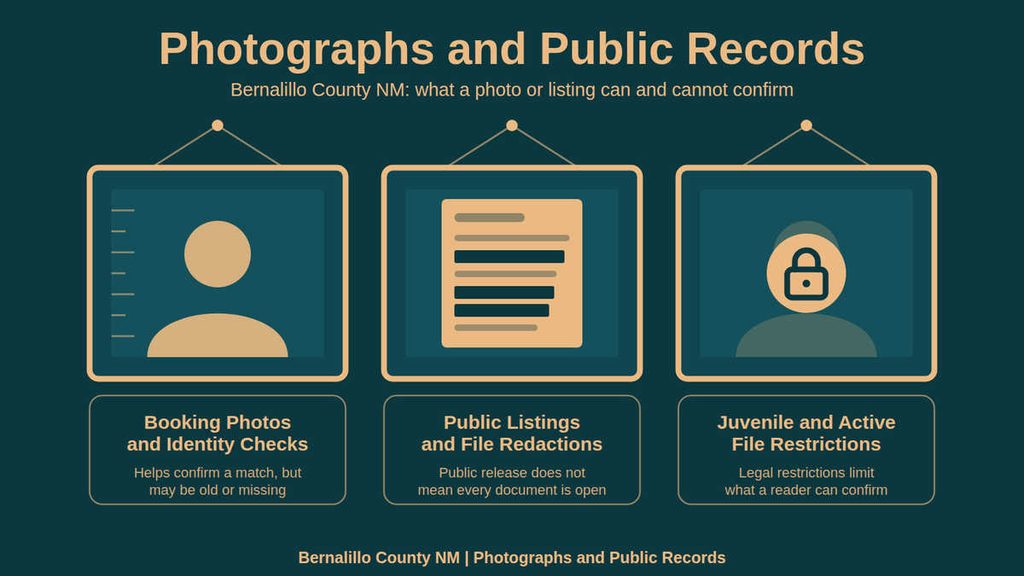
Booking Photos and Identity Checks
A booking photo may appear beside some jail listings. The source determines which entries receive a photo, so an arrest record without one does not prove that no booking occurred. A photo can help compare a known person with a listing, yet visual resemblance alone is not a reliable identity check.
Confirm at least two nonvisual facts when possible, such as date of birth, booking number, arrest date, case number, and agency. A person can also be booked under a legal name that differs from the name used in daily life. If the photo and typed fields point to different records, pause and ask the official custodian to resolve the match.
Public posting does not establish guilt. A booking image shows that the agency created a custody record at a stated time; it does not prove the charge or the court outcome. Share such images only for a lawful purpose, and avoid presenting a photo as proof of criminal guilt.
Public Listings and File Redactions
A public directory often contains short fields designed for quick identification. It may show a name, booking number, charge description, court date, bond amount, and custody status. It rarely contains the complete arrest report, every witness statement, or the full court file. That makes the directory useful for a first match but limited for building a complete case history.
Redacted fields can result from court orders, statutory exceptions, pending investigative work, privacy protections, or office release rules. New Mexico’s Open Records Act contains exceptions for certain records, including police and juvenile matters. The custodian must evaluate each request under the law, so the presence of one public record does not mean related files must be released.
Juvenile and Active File Restrictions
Juvenile records follow separate rules and should not be treated like ordinary adult case entries. A juvenile arrest, diversion matter, or court proceeding may be confidential, and the party allowed to obtain a copy may depend on the person’s age, the type of matter, and the court’s order. Use the juvenile court or the agency named for that matter instead of relying on a standard adult roster.
Unresolved cases can also carry separate limits. A current inmate listing may remain visible even when the underlying investigative file or court document cannot be released. An active warrant, a sealed filing, or a pending court event should be confirmed with the agency or court that holds the current status.
Record Accuracy and Missing Results
A missing search result can mean many things: the record is outside the portal’s scope, the date filter uses a different category, the name spelling differs, or the online file has not yet been updated. The right response depends on the source and the missing field. A careful search separates these causes before drawing a conclusion.
Update Delays and Missing Records
Office hours do not establish a database refresh cycle. A portal that does not show a last-updated time does not prove that records refresh daily, and a dated entry may still be several hours behind the case. Check the page for a timestamp and treat a listed status as valid only for that date and time.
Use this checklist after an empty or unclear result:
- Remove one filter at a time, starting with the date range, agency, and charge type.
- Try the legal name with and without a middle name, suffix, hyphen, or former name shown by the source.
- Compare arrest date, booking date, and court date instead of using the same date for all three.
- Search by booking number or full case number, since this can produce a match when a name search fails.
- Check whether the roster covers current inmates only or also includes people released after a stated date.
- Confirm that the arrest agency and custody facility were not mixed during the search.
- Look for the court named on the entry, since some court events never appear in the jail listing.
- Record the search date, filters, and spelling used before asking the official office for help.
After these checks, ask the county which office holds the missing record and whether an archived copy can be requested. A request for a historical record may follow a different process from an online roster search, so the county can direct you to the correct office and document type.
Expunged and Sealed Record Removal
Expunged and sealed records are not interchangeable. A court order determines what each label means in a particular case, and the online roster may not change at once after an order. Ask the court or custodian to confirm the current status rather than relying on an older search result.
A court or agency may retain a limited internal copy after public treatment changes. As a result, one person can see an entry in an internal system while another person sees no entry in an online directory. The exact result depends on the order and the source involved.
Legal Presumption of Innocence
An arrest record reports a legal event, not a proven crime. A person is presumed innocent until a court finds guilt, and an arrest can end with a dismissal, acquittal, or another outcome. Accurate reporting requires the court disposition rather than the booking label alone.
For a defensible arrest history, match the booking record to the court case and review the disposition. If the two sources conflict, preserve both entries, note the dates, and ask the official office which record reflects the current status. That method prevents a charge from being presented as a conviction and keeps the legal presumption of innocence intact.
Contact Information
Use Bernalillo County Government’s main phone line to ask which office holds a historical arrest record, whether a booking can be retrieved outside the current roster, and which court controls a related case. In-person requests can be directed to the county office listed below.
Frequently Asked Questions
Arrest records let you confirm a booking, find the responsible agency, and locate related court details. In Bernalillo County, the Sheriff’s Office and Metropolitan Detention Center keep custody files, while the appropriate court holds filings. Searching these sources helps you avoid mistakes, saves time, and ensures you have the correct case number before contacting an attorney or employer.
How can I search Bernalillo County arrest records by name?
Visit the Bernalillo County website and select the “Arrest Records Search” link. Enter the full name or partial name in the search box, then choose the desired date range. Click Search to view a list of matches, each showing booking date, arresting agency, and case number. Use the case number to retrieve court documents or contact the detention center for status updates.
Where do I find arrest records online for a specific date?
On the county portal, choose the “Search by Date” option. Input the exact arrest date or a range, then submit the query. Results display all arrests recorded on that day, including names, charges, and agency details. You can click any entry to see the full arrest report and any linked court information.
Can I look up arrest records by arresting agency?
Yes. Select the “Agency Filter” on the search page and pick the Sheriff’s Office, Metropolitan Detention Center, or any local police department. After applying the filter, the system returns only records handled by that agency. This view helps you narrow results when you know which department made the arrest.
What information is included in a public arrest record?
A public arrest record typically lists the arrested person’s name, date of birth, booking date, charges, arresting agency, and case number. It may also show bond amount, court date, and detention location. Some records include a brief incident summary, but personal details beyond the arrest are omitted for privacy.
How do I obtain a copy of an arrest report for employment background checks?
First, locate the record using the online search tools described above. Note the case number and agency name. Contact the Bernalillo County Clerk’s Office with the case number and request an official copy. Provide a valid photo ID and pay any required fee. The clerk will issue a certified copy suitable for employers.
Are there any fees for searching arrest records in Bernalillo County?
Searching the database is free. However, printing, certified copies, or detailed reports may carry a small charge. Fees vary by service; the county website lists current rates. If you need a full arrest report, expect a modest fee for processing and mailing.